
Have updated the the Home Forward Board packet in right pane under Home Forward YTD Board Packages. (Be patient, file is now 600 pages+, so will take a while to download).
On PDF page 26 for the July 17th Board meeting XO Steve Rudman report says that Home Forward kids are 7% of all Multnomah county kids in kindergarten. (you can add that to the long list of stuff I did NOT know).
A kindergarden round up report beginning on PDF page 31 provides more details about what Home Forward is doing to work with families with children. ( Similar demographic data should be available for LIHTC properties, but don't get me started..).
Highly recommended reading.
Anyone else see a need to connect Oregon families and children in HUD assisted and LIHTC properties to Oregon's "Prosperity Initiative"?
Originally created and posted on the Oregon Housing Blog.
Showing posts with label children. Show all posts
Showing posts with label children. Show all posts
Thursday, July 11, 2013


Sunday, February 5, 2012
Corrected: Oregon Legislature: In Every Republican House and Senate District Renters Were More Likely than Home Owners to Have Children Less than Age Six.
Correction:
In text below I corrected percentage of Democratic held districts where renter HH were more likely than home owners to have child below age of 18 to read 54%, instead my original 72%; data in linked tables remains accurate.
---------------
I recently posted (HERE) that in Oregon renters were 56% more likely than home owners to have children below the age of 6.
That got me thinking, I wonder if there were any differences between state legislative districts held by Republicans and Democrats?
Well, it turns out that there were differences, but they weren't what most people (including me) likely expected....
In text below I corrected percentage of Democratic held districts where renter HH were more likely than home owners to have child below age of 18 to read 54%, instead my original 72%; data in linked tables remains accurate.
---------------
I recently posted (HERE) that in Oregon renters were 56% more likely than home owners to have children below the age of 6.
That got me thinking, I wonder if there were any differences between state legislative districts held by Republicans and Democrats?
Well, it turns out that there were differences, but they weren't what most people (including me) likely expected....
Children Under Age Six
In EVERY Republican Held District Renters Were More Likely than Home Owners to Have a Child Less than Age Six
In EVERY Republican Held District Renters Were More Likely than Home Owners to Have a Child Less than Age Six
It turns out that in EVERY Republican legislative district (44 out of 44) it was more likely that renter households had children less than age 6 when compared to home owners.
For Democratic held districts, renters were more likely that home owner households to have a child less than age six 72% of the time (33 out of 46 districts).
Combined, in 77 of the 90 legislative districts (86%) it was more likely that renter households would include a child less than age 6 vs home owner households.
Combined, in 77 of the 90 legislative districts (86%) it was more likely that renter households would include a child less than age 6 vs home owner households.
All Children Less than 18
When looking at all children under 18, for Republican held districts renters were more likely than home owners to have a child less than eighteen 86% of the time ( 38 of 44).
However in Democratic held districts, renters were more likely than home owners to have a child only 54% of the time ( 25 out of 46 districts).
Combined, in 63 of the 90 districts (70%) it was more likely that renter households would include a child less than 18 vs. home owner households.
TABLES
The table I constructed HERE provides a summary for each chamber and for the combined chambers, as well as a break out by party.
Combined, in 63 of the 90 districts (70%) it was more likely that renter households would include a child less than 18 vs. home owner households.
TABLES
The table I constructed HERE provides a summary for each chamber and for the combined chambers, as well as a break out by party.
The legal sized PDF table I constructed HERE has the relevant percentages for each Oregon legislative district. The table is sorted by numerical order of Senate and House seats and includes the member name and party.
The bookmark HERE will take you to the Census 2010 data table for Oregon Legislative Districts (HCT 11) that I used to do my calculations.
Originally created and posted on the Oregon Housing Blog.
Originally created and posted on the Oregon Housing Blog.
Thursday, January 26, 2012
Who Knew? Oregon Renter Households 56% MORE Likely to Have Children Under 6 Than Owner Occupied Households
Took a glance at new Oregon Census 2010 data released today.
Census 2010 Table HCT11 (TENURE BY PRESENCE AND AGE OF RELATED CHILDREN) has counts of children by tenure. My calculations:
Statewide in Oregon, for children less than 6 years old, renter households were 56% more likely to to have children of this age than were owner occupied households; 9.3% of
renter households have children less than age six and 5.9% of all owner occupied households had children less than age 6. ( 9.3%/5.6%-1= 56%).
Oregon School Districts: In 95% of Districts, Renter Households More Likely than Owner Occupants to Have Children Less than Age Six ; One BIG Exception.
I also took look at Oregon School District Data, and it appears that in 183 of 192 (95%) Oregon school districts, renter households were MORE likely than owner occupant households to have children less than age six.
A notable exception was the Portland School District 1J where renter households were 37% less likely than owner occupant households to have children less than age six.
All Children
Statewide in Oregon, renter households were 10% more likely to have children
of all ages than owner occupied households; 31.3% of renter households had children
and 28.4% of owner occupied households had children. ( 31.3%/28.4%-1= 10%).
Note:
Because the overall number of owner occupant households were more than the number of renter households, 60% of the total households with children were owner occupant households and 40% were renter households.
However, of the total Oregon number of households with children less than six years old, nearly a majority of those, 49%, were renter households.
These are counts of households with children and not population counts of children.
Originally created and posted on the Oregon Housing Blog.
Tuesday, January 10, 2012
Projection: 57,000+Oregon Children Served in LIHTC, Voucher, Project Based S 8, and Public Housing Programs; Improvements Next Year Should Provide Rich Local Detail.
I recently completed a review of tenant data from a LIHTC data base provided to me by OHCS staff. This database has a number of shortcomings that should be greatly improved next year, but for now I was able to develop a projection of children served by the LIHTC program in Oregon. I then combined that projection with projections of children served by the HUD voucher, HUD Project Based Section 8, and public housing programs.
A simple breakout of the 57,597 projected children served by these select subsidized housing programs is in the table below; the detailed table HERE shows how data was calculated and also data sources.

Oregon Children Served by TANF Likely Less Than Children Served by All Subsidized Rental Programs.
As a point of reference, the latest TANF reports show a total of 59,000 Oregon children served by the single parent and dual parent TANF programs.
The 57,597 assisted rental housing child count in this projection does not include children in units funded by HOME, CDBG, or HUD Homeless funding unless they also live in a LIHTC, Project Based Section 8 or public housing unit or are receiving a HUD voucher.
This projection also does not include counts of children in Rural Development assisted rental units unless that unit is also a LIHTC unit or receiving project based Section 8 or the family is receiving HUD voucher assistance.
If those programs were included I am confident that the count of children served by subsidized housing programs would exceed the 59,000 children served by the TANF program in Oregon.
As a point of reference, the latest TANF reports show a total of 59,000 Oregon children served by the single parent and dual parent TANF programs.
The 57,597 assisted rental housing child count in this projection does not include children in units funded by HOME, CDBG, or HUD Homeless funding unless they also live in a LIHTC, Project Based Section 8 or public housing unit or are receiving a HUD voucher.
This projection also does not include counts of children in Rural Development assisted rental units unless that unit is also a LIHTC unit or receiving project based Section 8 or the family is receiving HUD voucher assistance.
If those programs were included I am confident that the count of children served by subsidized housing programs would exceed the 59,000 children served by the TANF program in Oregon.
Improvements in Data Reporting Coming Next Year, Including Local Data
This first statewide estimate of children served by these programs is a prelude to what should be a enhanced version of tenant demographic data reporting for next year, including geographic data down to at least the county level.
This first statewide estimate of children served by these programs is a prelude to what should be a enhanced version of tenant demographic data reporting for next year, including geographic data down to at least the county level.
OHCS staff have advised that tenant demographic reporting will begin in the new year using software that should greatly improve the completeness and accuracy of tenant data reporting. In addition to being able to drill down to geography below the state level the tenant data should allow timely reporting of elderly and disabled households served by the LIHTC program as well as providing information about tenant incomes and race and ethnicity.
Improved reporting will allow all of us to see more clearly at the local level detailed demographics of the residents helped by assisted housing rental programs in Oregon.
BIG thanks to OHCS Chief Information Officer Bill Carpenter and his staffer Ron Pickett for the time and effort that made it possible to produce this initial effort and for their work to expand and localize this demographic data in the coming year.
Wednesday, August 17, 2011
State of America's Children Report Out, Includes Some Oregon Data.
Report is HERE.
Lots of data, encourage browsing entire report. Some Oregon examples below. (Oregon 2009 population data found on various tables, including PDF pages 28-33, pg 46-47, pg 49):
- Children were 22.8% of Oregon's population, in contrast, the 65 and older population in Oregon numbered 517,000 or 13.5% of the total population. This means that the share of Oregon's population that were children is 69% larger than the elderly share of Oregon's population. (22.8%/13.5%-1=69%).
- 164,000 Oregon children lived in poverty, 19.2% of all Oregon children.
- Of 879,000 children in Oregon 32%, 279,000, are minority [Nationwide, minority children were 44.7% of total population].
- Rankings by share of children in state--Oregon's highest rank (10th) was for American Indian/Alaska Native who represented 2% of Oregon's children and the next highest rank was for Hispanic children (12th) who represented 19.8% of Oregon's children.
Only housing data in report is NLIHC Out of Reach affordability data on page 78. This was BIG missed opportunity for HUD to highlight number of children served by HUD assisted housing.
Wednesday, December 29, 2010
Urban Institute Has Extensive Evaluation of Chicago PHA Family Case Management Demonstration Program.
Main page for this research is HERE.
The Supporting Vulnerable Public Housing Families Chicago Family Case Management Demonstration, an innovative effort to test the feasibility of using public and assisted housing as a platform for providing services to vulnerable families. The Chicago Family Case Management Demonstration has produced a successful model for providing wraparound services to residents in public and assisted housing settings. The briefs in this series describe service implementation and costs, along with participant outcomes across four domains: employment, health, housing and relocation, and children and youth.
Evaluation of 6 different topics are included in this research:
- An Overview of the Chicago Family Case Management Demonstration
- A New Model for Integrating Housing and Services
- Tackling the Biggest Challenge: Intensive Case Management and CHA Residents’ Health
- Moving "Hard to House" Residents to Work: The Role of Intensive Case Management
- Relocating Vulnerable Public Housing Families
- Reaching the Next Generation: The Crisis for CHA's Youth
Tuesday, December 7, 2010
Basic Facts About Low Income Children, 2009
Relevant to Kitzhaber stated goal of focusing on children, new National Center for Children in Poverty paper is HERE.
Only housing bit (pg 6) is :
children living in low-income families were two times more likely to have moved in the past year and two times less likely to live in families that own a home.
(Move % was 18% vs 9%; ownership % was 39% vs 81%).
Originally created and posted on the Oregon Housing Blog.
Tuesday, November 17, 2009
Off Topic: Single Electronic Application Serves Multiple Social Service Programs.
A single electronic application to meet the needs of several social service programs is the goal of One-e-App, now in operation in four states. (A listing of areas can be found HERE, click on left pane to see details for each area).
The list of programs HERE does NOT currently include housing assistance, but does include food stamps, medicaid, TANF, and the Earned Income Tax Credit.
Originally created and posted on the Oregon Housing Blog.
The list of programs HERE does NOT currently include housing assistance, but does include food stamps, medicaid, TANF, and the Earned Income Tax Credit.
Originally created and posted on the Oregon Housing Blog.
Tuesday, March 10, 2009
Updated: Child Homeless Report; Oregon Ranked 26th.
Corrected national report link; added second link to longer version of Oregon report
- National report is HERE.
- Two page Oregon report is HERE. (Includes data on food security, health, and educational data for homeless children). Longer version is HERE.
- Washington Post story HERE.
Saturday, May 17, 2008
CBO Testimony on Children Without Health Insurance.
I have previously blogged about health care insurance programs for uninsured children, and notably SCHIP, HERE, HERE, and HERE.
The head of the Congressional Budget Office recently testified about SCHIP HERE. His balanced testimony includes both identification of key issues, as well as accomplishments, of the SCHIP program.
The head of the Congressional Budget Office recently testified about SCHIP HERE. His balanced testimony includes both identification of key issues, as well as accomplishments, of the SCHIP program.
Saturday, December 1, 2007
One Laptop Per Child Orders Surge.
Good story today in Boston Globe HERE about One Laptop Per Child program progress.
Story says Peru has signed order for 260,000 laptops and that so far the Give One Get One donation campaign running through end of December, has produced 190,000 orders to date, with half going to donors and half being donated for kids in countries overseas. That suggests my earlier post projecting 200,000 donated laptops will almost certainly be substantially exceeded, with nearly full month left in donor campaign.
Based on email I saw as a donor, I expect to see my donor laptop arrive sometime after middle of month and will shoot and post some pics after arrival.
Story says Peru has signed order for 260,000 laptops and that so far the Give One Get One donation campaign running through end of December, has produced 190,000 orders to date, with half going to donors and half being donated for kids in countries overseas. That suggests my earlier post projecting 200,000 donated laptops will almost certainly be substantially exceeded, with nearly full month left in donor campaign.
Based on email I saw as a donor, I expect to see my donor laptop arrive sometime after middle of month and will shoot and post some pics after arrival.
Saturday, November 24, 2007
One Laptop Per Child Campaign Extended to Dec. 31; $$ Donated So Far May Already Pay for 50,000+ Laptops for Kids Overseas.
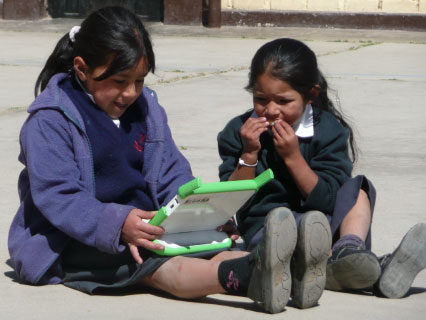
A One Laptop Per Child [OLPC] press release HERE announces that their “Give one, Get One” [GOGO] funding campaign for PC donations is being extended until December 31, roughly three times the length of the initial planned campaign period.
[My prior posting on GOGO is HERE; that posting discloses that I am a GOGO donor].
One take on this extension is that like an “extended sales period” ad one might see in the newspaper, this could signal that the GOGO campaign is falling short of expectations.
However, the press release suggests otherwise, indicating that donations of "$2 million per day" have been received. As the release also references the first "10 days" this would suggest total donations during that period of $20 Million.
At an assumed cost per PC of $200, $20M. in donations during the first 10 days would provide funding for 100,000 laptops; 50,000 laptops for donors and 50,000 laptops to be sent overseas. (My guess is that if $20M. is accurate more than 50,000 laptops will go overseas as some larger donors likely opted to NOT keep all of their “donor” laptops and to send them overseas instead).
Even If donations during the remaining two thirds+ of the campaign only equal what was donated during the first one third, that would still mean sufficient funding for 200,000 laptops, with at least 100,000 of those laptops going overseas. (These figures would be higher of course if donations are closer to the pace of the first ten days).
While I have seen no public information on GOGO goals, these hefty response levels suggest there is a very good chance that OLPC will look carefully at continuing and expanding this method of funding the cost of laptops to create incentives for more overseas governments to purchase laptops to help their children.
Monday, October 8, 2007
Healthy Kids Measure: Feds Share Is 61%, But State May Pay $192 Million For 50,000 Kids @200-300% of Poverty Level
My earlier piece focused on SCHIP cost sharing and income eligibility. The two page PDF HERE has some facts and comments on November Ballot Measure 50, the Healthy Kids initiative.
Note especially:
1. The expectation that feds share will be 61%.(Fed share could increase if national SCHIP legislation permits eligibility beyond 200% of poverty level).
2. In service of the overall goal of near universal health care coverage for children, it appears that the State of Oregon may be willing to pay MORE per child in higher income families than it currently pays for lower income children in families eligible for Medicaid or SCHIP.
3. Unlike the typical "30% of income" tenant rent contribution used in rental housing assistance programs, there appears to be little expectation that new health care beneficiaries will make any standard or significant contribution via premium payments or co-pays.
Note especially:
1. The expectation that feds share will be 61%.(Fed share could increase if national SCHIP legislation permits eligibility beyond 200% of poverty level).
2. In service of the overall goal of near universal health care coverage for children, it appears that the State of Oregon may be willing to pay MORE per child in higher income families than it currently pays for lower income children in families eligible for Medicaid or SCHIP.
3. Unlike the typical "30% of income" tenant rent contribution used in rental housing assistance programs, there appears to be little expectation that new health care beneficiaries will make any standard or significant contribution via premium payments or co-pays.
Friday, October 5, 2007
SCHIP Debate: Some Oregon Facts and A Few Comments
With the national discussion on SCHIP gearing up, I thought it might be useful to dig out some facts about kids and health insurance in Oregon. As is the case with housing assistance, the SCHIP debate is first and foremost a political debate. However some of the same policy debates about income targeting and cost sharing we see in housing lie below the surface of the larger political debate.
If your interested, I have prepared this short PDF summary highlighting some of the relevant Oregon data.
Tuesday, September 25, 2007
06-05 HH Change: Props For Some Pops; For HH with Own Children Under 18 , Male Headed HH's Were Only HH Category to Increase.
I did a previous piece on 2005 Households types from the American Community Survey for Oregon HERE. I will do an 2006 update to the earlier piece which will include more data on tenure in a few days. (Note below however that there was an estimated 5,600 decline in Oregon renter HH's and the addition of 30,000+ homeowners from 2006-2005).
The table below provides a quick snapshot of ACS estimates of the 2006-2005 CHANGE in Oregon HH's, focused on households with their own children less than 18 years of age.

The table below provides a quick snapshot of ACS estimates of the 2006-2005 CHANGE in Oregon HH's, focused on households with their own children less than 18 years of age.
Select 2006-2005 Oregon Household Changes from ACS:
| All Households INCREASED | +24,322 | |
| Renter Households DECREASED | | (5, 688) |
| Homeowner Households INCREASED | | +30,010 |
| Households with Own Children Less than 18 INCREASED | +1,070 | |
| Married Couple Families with Own Children Less than 18 DECREASED | | (-363) |
| Female Household Families with Own Children less than 18 DECREASED | | (-1,555) |
| Male Household Families with Own Children less than 18 INCREASED | | +2,988 |
Thursday, August 2, 2007
New HOPE VI Studies from Urban Institute-5 Cities/Projects Studied Did NOT Include Any Northwest HOPE VI Cities or Projects.
The Housing Authority of Portland [HAP] has done a very good job with the HOPE VI public housing redevelopment at New Columbia and is moving forward swiftly with their second HOPE VI development , Humboldt Gardens.
Unfortunately not all HOPE VI programs have been as well planned and executed as those two HAP projects. (For example, the project I grew up in Detroit has had a HOPE VI grant for more decade and to my knowledge reconstruction has yet to start).
The Urban Institute Metropolitan Housing & Communities Policy Center recently published a series of HOPE VI related reports/briefs that took a look impacts and issues from a national perspective. [This was likely the result of a HUD contract].
It is important to note that the reports DID NOT include HOPE VI projects in Portland (or anyplace in the NW for that matter). The report studied results for 887 families in just 5 cities and in these developments: Ida B. Wells/ Madden Park Homes in Chicago, Ill.; Easter Hill in Richmond, Calif.; Shore Park/Shore Terrace in Atlantic City, N.J.; Few Gardens in Durham, N.C.; and East Capitol Dwellings in Washington.
1. HOPE VI'd and On the Move.
2. Housing Choice Vouchers.
3. Moving On: Benefits and Challenges of HOPE VI for Children.
4. Poor Health: Adding Insult to Injury for HOPE VI Families.
5. Are HOPE VI Families at Greater Risk for Homelessness?
6. Relocation Is Not Enough.
7. Safety is the Most Important Thing: How HOPE VI Helped Families.
8. Estimating the Public Costs and Benefits.
Subscribe to:
Posts (Atom)


